Salesforce Administrators have always been at the center of how organizations run their most critical systems. But as AI, automation, and agents reshape the way work gets done, the admin role is evolving faster than ever.
“Admins in the Agentic Era” is a series exploring how Salesforce Admins are evolving to run the Agentic Enterprise. We spotlight leaders who are experimenting, advising, and redefining how modern systems are built, governed, and scaled.
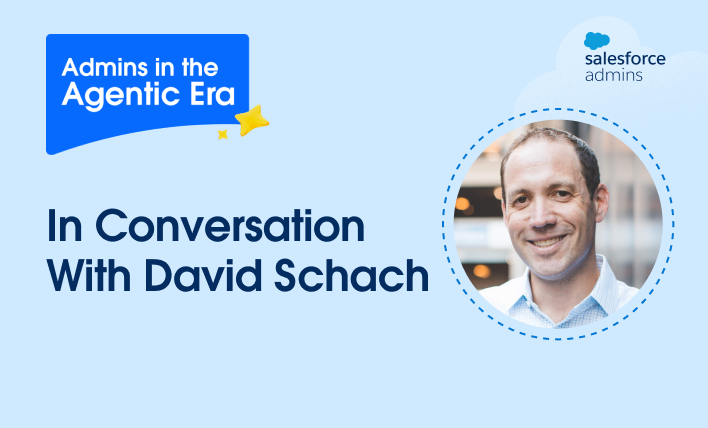
In conversation with David Schach
David is an Enterprise Technical Architect with 20 years of experience architecting, building, and optimizing Salesforce implementations across multiple clouds and industries. He specializes in development, governance, security, and extensibility.
He’s also a recognized Salesforce community leader and open-source contributor to popular Salesforce projects while working as a consultant and ISV. His latest passion is DevSecOps, using quality and security analysis tools to help companies enforce standards based on best practices.
What feels different about the admin role right now?
The role has shifted from general builder/fixer to guardian of the org and its roadmap. We’re no longer just building; we’re enforcing and protecting through disciplined testing in sandboxes and scratch orgs.
There’s also a growing need for admins to have a veto on feature requests. As systems become more autonomous, admins must step up and (gently) say “no” to requests that aren’t measurable, maintainable, and sustainable — working closely with enterprise architects.
Admins are the stewards of well-governed orgs. With tools like Agentforce, AI can handle the mechanical parts of the org, analyzing what’s in a permission set or checking naming standards, but admins must define those standards first. Without strong metadata, automation frameworks, and data quality, AI has nothing to build on. The entire stack is important, and the admin is accountable for all of it.
Where are you currently experimenting with AI, automation, or new governance approaches?
My current focus is on Service Cloud and the new Agent Builder.
- Cost-Protective Deployment: We’re testing gating patterns — using standard Salesforce chatbots up front and only invoking Agentforce when necessary, while keeping it invisible to the user. Unprotected agents on public sites can quickly drive up costs, so entry points matter.
- Website Deployments: Agents can be deployed across Experience Cloud (Aura or LWR), Visualforce, external websites, or as backend chat services. We’re digging deep into customizations for all of these, where even seemingly minor details like corporate branding can impact success.
- Agent Script and Builder: The deterministic aspects of Agent Script are impressive, and even more so, agents can help build agents. You define the goal, iterate, refine, and quickly move to production-ready configurations. I played with a prototype recently, and it is going to make creating effective agents so much easier.
- Agent Testing: The latest release is mind-blowing. Consistent, real-world inputs power agent conversation tests (like Apex test data, but pulled anonymously from actual chats), ensuring predictable outcomes. The observability and testing suites make me confident that we are deploying exactly what we intend to deploy. We could be in an age of admin-led, test-driven agent development.
With all of this, I think about pros and cons of each decision choice, and I start to solidify best practices while considering how many can be enforced in version control quality gates.
What excites you, and what concerns you, about the rise of autonomous systems?
The excitement
The delight factor. When you use natural language correctly, it’s amazing. We can now build tools that draw off the entire company knowledge base and website. Users want this — even if they don’t know it yet — and we have the chance to move beyond efficiency and output to delighting the user.
Agents make Apex more flexible. For example, I just built an integration action with Apex, and while the Apex says to use a specific endpoint for the callout, the agent can call out to a different endpoint based on instructions. The agent can reach into what used to be a rigid codebase that needed to account for any kind of input and can change how the code runs. Another example: The agent needs a date from the user, who says “tomorrow.” The agent can, if instructed, translate that word to a date in a specific format so an integration endpoint can consume it and give the agent data to present to the user. No need to build fuzzy response matching into your Apex or Flow!
The concern
The gap between what executives request and what is actually useful. Often, the best use case isn’t what is requested. My concern is the “everything is top priority” and “bright shiny object” culture migrating into AI. Without a Center of Excellence (COE) and a strict policy designed to put the brakes on fast-tracking feature deployments, we risk building agents that are unmanageable or financially dangerous without deliberate forethought, meticulous permissioning, and well-written prompts and instructions.
Here’s a true story: Someone said, “We need to use AI.” I asked, “Great! What do you want to use it for?” “To be more efficient,” they said. That was an invitation to have a different conversation where I could present some ideas, but by itself, that’s not going to lead to improved outcomes, and it will turn into a whirl of expanding scope and costs. Have the conversations, and remember that building yourself into a corner will cost far more than pausing and putting everything into context and making thoughtful decisions.
What skills do you believe admins need to build next?
The technical bar has moved. Admins don’t need to be developers, but they do need to speak the language.
Application Lifecycle Management (ALM) and Pipeline Literacy
Understand GitHub, pull requests, and pipeline structures. What quality tools and rules does the company use? Which metadata types are examined? Admins should be able to describe the pipeline workflows and to have input on quality rules and gates. When do you run Apex tests? When does your scheduled Apex compilation happen? Do you require a compliance category and a description for every field, and is there a minimum required length?
I have a challenge for all admins: Take some time and consider how you might convert your org to unlocked packages instead of a monolithic single-folder metadata soup. Present that to your architecture/developer team and start that process. There are myriad benefits, including faster deployments, which will make many people happy.
Service Cloud and Omni-Channel
These are no longer niche skills; they are the foundation for Agentforce. If you want to skill up, learn the Service Cloud deployment modules.
Routing takes place in flows, and the agent is linked to Messaging Channels, Embedded Service Deployments, and more. Learn to pass chats with context to human customer service, and delight that team by auto-summarizing chats and doing sentiment analysis before they open the Case. Trust me — they’ll thank you!
Metadata as Context
Because agents rely on natural language, the way we label fields, write descriptions and help text, and name custom labels matters more than ever. The logic depends even more on metadata we used to think was purely for user/admin experience. This means nothing if you aren’t enforcing standards for completeness, and here we are back to governance.
UX/CX Design
Start exploring rich content in the Agentforce chat window and custom Lightning web components for input and output at various stages of an interaction. (Wouldn’t a picklist or date picker be useful sometimes?) Something as simple as displaying a summary of what happened during the chat, but in a branded Lightning web component using emoji, logos, and images, can go a long way to make the tool feel more accessible to users.
Prompt Engineering (The “Why” over the “How”)
The skill is asking the right questions and knowing which parts of the tool are most effective for each desired outcome. Agent, topic, and action descriptions and instructions are powerful tools that have a tremendous effect on agent behavior. There are also context variables, custom fields, platform cache, custom Lightning Types, Agent Script logic, and other tools at your disposal. All of these contribute to an agent’s behavior, and you need to teach the agent which topic and which action to take — and not to take.
Agent Script Literacy
I’ve always said that the best admins don’t need to write code, but they need to know what it can do and, ideally, how to read it. The same goes for Agent Script. With the new agents for building agents, we risk Agent Script that is difficult to read, debug, and extend. Being able to read Agent Script and explain what it does, with all the instructions and branching logic, is key.
In your words, what does it mean to be a next-gen admin?
A next-gen admin is a partner and trusted advisor; someone who works closely with developers and architects, enforces standards, and triages org changes early. It’s someone who is involved early in the process and is empowered to say, “I can’t manage that if you build it that way.”
They help stakeholders distinguish between “want” and “need,” and probe for the underlying desired outcomes. They coach them to present concrete metrics for success, and agree on scope and features before you begin.
It also means being a steward of maintainability. You are the one who ensures that every topic and its action(s) are specific, restricted by minimal permissions, and aligned with a clear decision framework. You aren’t just a builder; you’re the person who ensures the entire company’s knowledge is served up safely, standardly, and sustainably.
There are numerous tools available (my favorites are the latest Agentforce observability and testing suites), so become familiar with what you can use and choose the best tool for the job. It won’t always be Agentforce, so know when to use each Salesforce tool and the guardrails needed for each one.
Above all, be a trusted advisor. If someone asks you to do something that doesn’t feel safe or secure, say something. You are here to be a catalyst, a force-multiplier. I like to be a monarch-maker, the one who makes other people look great. The best next-gen admins will be those that counsel upwards on what to do — and what not to do.
If you don’t know how to do something, and you can’t find it documented anywhere, ASK Salesforce to post it. Contact someone on the Admin Relations team, and say, “Hi, I’d like to do this and to connect it to that, but I can’t find anything documented. Can you please help me with a blog post?” All the advocate teams are looking for blog material, and they love to write new content with realistic examples. Let Salesforce do some work for you; we’ll all benefit!
The conversation is just getting started
The role of admins in the Agentic Era is still being defined — and your voice matters. What skills are you building? What questions are you wrestling with? Join the conversation.
Resources