Admins aren’t just system builders
The Salesforce Admin role is evolving with an ever-changing platform and the advancement of AI. Admins are no longer just system builders—we’re relationship builders and governors of behavior, and that transition starts with trust.
When an organization has trust, it experiences faster adoption, better requirements, and fewer fire drills. Who doesn’t want that? Without trust, admins get stuck in a mode of reactivity, constantly responding to missed expectations rather than proactively guiding Salesforce strategy.
Why trust is the foundation of strategic admin work
What does trust mean in the admin role as we work with stakeholders? First, let’s define the stakeholder role. Stakeholders might fill different roles at your organization. They might be members of leadership, users helping to define the processes you’re automating as an admin— really any person in the business with an interest, concern, or investment in your CRM.
Let’s paint a picture of what an ideal admin/stakeholder relationship looks like so we have some goals to work toward.
- Stakeholders believe you understand their work.
- Stakeholders feel heard before solutions are proposed.
- Stakeholders trust not only your execution but also your recommendations.
- Stakeholders see you as a true strategic partner.
Discovery builds credibility
Those are some lofty goals if you’re starting from an estranged relationship with your stakeholders and just laying the foundation of trust. The best way to build trust is to start with curiosity rather than configuration.
Put your demos aside for a moment and ask questions so that you can not only learn the processes but also uncover the pain points. This will help you find quick wins you can achieve to build trust through hard work.
As admins, it’s really easy for us to see a problem and inherently know how we would fix it through configuration, so this step can be challenging. It isn’t about us solving the problem—it’s about listening and collaborating to achieve the desired end state or dream solution!
Some questions you can ask to kick off these discovery conversations include:
- Can you walk me through your process step by step?
- What’s the hardest part of this process to accomplish and why? In an ideal world, what would make this easier?
- Where do things fall between the cracks?
- What is working well in this process?
You can also get firsthand experience by shadowing your users as they work. In an office we call this SABWA (Salesforce Administration By Walking Around), but if you’re a remote employee it can still work. Set up time with your users and simply watch, take notes, and ask questions as you see them get stuck or frustrated.
As you discover, resist the temptation to solution. I know it can be a HUGE challenge to not “Salesforce” something and to instead be mindful of turning our technical language into business outcomes. Since admins sit between technology and business, an essential way to build trust is to build understanding by mapping business goals to Salesforce configuration. Trust grows when everyone has a mutual level of understanding.
Wins, constraints, and feedback
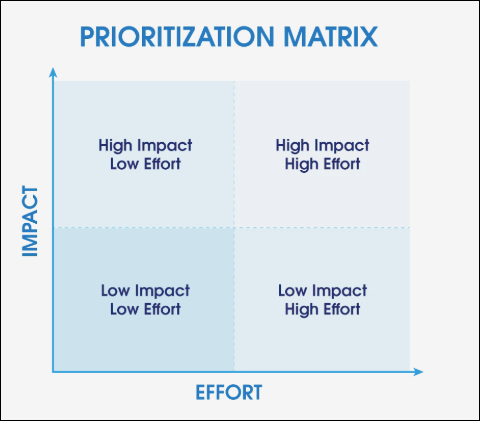
Okay, I know you’ve been waiting for it… It’s time to take that discovery work and start building! Since you’ve talked to your stakeholders and watched them at work, you probably have a solid sense of some quick wins to solve. Next, you can use a Prioritization matrix to help you determine which wins to deliver first, focusing on Low Effort/High Impact.
Showing progress early and often continues to grow trust, and reliability builds confidence. But don’t just deliver, check in. Close the loop after changes are made by sharing:
- What changed
- Why it matters
- How to use it
Use these communications to be honest about the constraints you face, to gather (and encourage) feedback so you can continue to iterate and improve solutions, and to share out any impact measures you’ve been tracking. Your user stakeholders will feel heard and included. Your leadership stakeholders will celebrate the increased adoption, time savings, and data quality improvements you’re tracking.
Monitoring and maintaining trust
Trust is ever evolving and something you need to continually work on. And like any other relationship, your stakeholder relationship will undergo stress when trust breaks (and it will). When we normalize it and can have transparent conversations about missed expectations, bugs, and competing priorities, we can continue to grow and recover.
Creating a backlog to say no (or not yet) collaboratively with your stakeholders helps provide clarity on competing priorities, limitations, and system implications. Stakeholders trust admins who protect not only the system but also the business. Including your stakeholders in conversations creates shared ownership which increases buy-in.
Get started with these trust-building habits
As the admin role continues to evolve and we’re brought into more stakeholder conversations, trust is integral to our success. Don’t wait to be invited to step into this role—take action now to begin building trust. Here are some habits to adopt right away.
- Identify one stakeholder relationship you need to strengthen at your organization. Where should you prioritize your attention?
- Schedule (at least) one stakeholder listening session. Ask questions and don’t provide any solutions.
- Send a regular Salesforce update to your stakeholders. Let them know what’s new and what your priorities are.
- Add impact statements to every project. Make the problem, action, and measurable changes clear to level-set on goals.
- Track and share measurable impacts. Like how much time was saved, what is the adoption rate, etc.
- Create a feedback loop. Host a call, send out a survey, talk to your users, and report back to them.
Resources