As Salesforce Admins, we’ve always been trusted with the hard stuff: business process, system integrity, and outcomes the business can rely on. We’re the ones who translate how work should happen into systems that actually make it happen—securely, consistently, and at scale.
In 2026, that responsibility isn’t going away. It expands.
There’s a difference between experimenting with AI and operating an agentic enterprise. One is optional. The other is embedded directly into how work gets done. And once AI becomes operational, admins are the ones responsible for making it secure, governed, and effective.
My relationship with AI, Agentforce, and the broader Salesforce Platform now feels a lot like James Bond and Q. I don’t always need to know exactly how the tools are built, but I trust them. I use them constantly. And most of the time, I can’t envision a meaningful project that doesn’t involve them in some way.
That comfort came from doing what admins have always done best: configuring, testing, governing, and deploying technology inside real business processes. Which is why one particular discovery during my Agentblazer Innovator work stopped me in my tracks: Agentforce Service Assistant.
Not because it’s flashy. Not because it replaces people. But because it’s one of the clearest on-ramps we have today for building an agentic workforce.
Discovering Agentforce Service Assistant (and why it clicked immediately)
While working through Trailhead modules and related learning, I was introduced to Service Assistant. Even knowing how broad the Salesforce Platform is, I still have moments where I say, “Wait—this exists?”
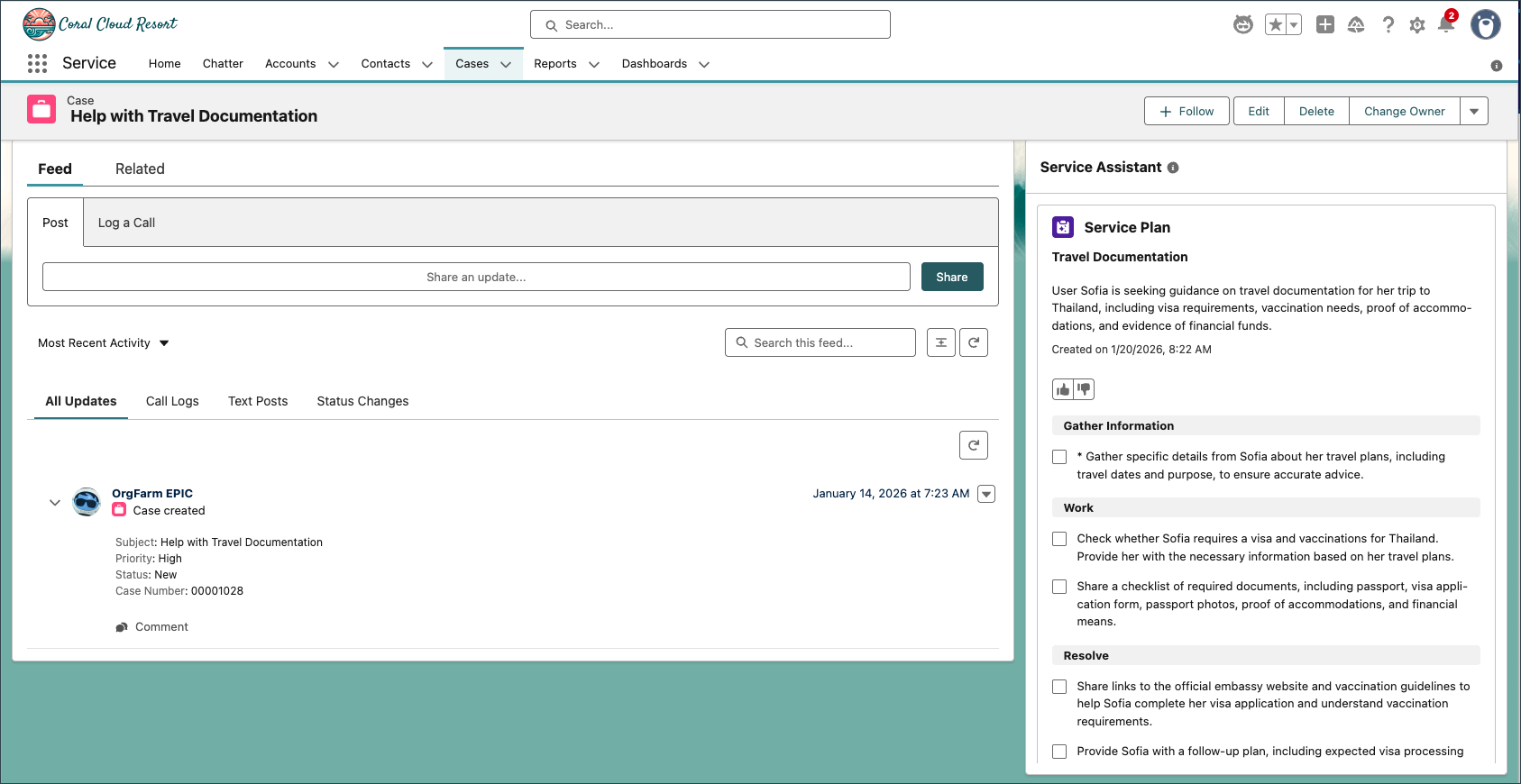
Service Assistant is an assistive AI agent that lives directly on the Case record page.
By automatically summarizing cases and offering guided resolution steps, Service Assistant reduces cognitive load for reps while keeping humans firmly in control. And because it operates within Salesforce’s existing security and trust model, admins don’t have to choose between innovation and governance. Delivered as a Lightning web component, it’s designed specifically for service reps. When a case opens, Service Assistant automatically provides:
A clear, concise case summary
Context pulled directly from the record
Optional step-by-step resolution guidance, called a service plan
No prompting. No training users to ask the right question. No disruption to existing workflows.
It’s simply there—supporting the user inside the process they already follow.
Here’s a quick look at Service Assistant in action—and why it feels so natural inside the Service workflow.
And that’s when the light bulb went on.
Not because this was flashy AI—but because this was admin-grade AI. Grounded in process. Governed by configuration. Designed to produce consistent outcomes at scale.
Why “just being there” matters more than you think
One of the biggest barriers to AI adoption isn’t fear—it’s friction.
If users have to stop what they’re doing, think about how to ask AI for help, or switch contexts entirely, adoption drops fast. Service Assistant removes that friction by meeting users exactly where they already work.
From an admin perspective, this is where trust is built.
You’re not asking Service to change how users work. You’re reinforcing existing processes with better guidance, delivered consistently and at the right moment.
That’s how AI earns credibility inside an organization.
The real power is behind the scenes
Here’s where Service Assistant really becomes an admin tool.
While it feels simple to users, the value comes from how admins configure it. Service plans aren’t generic instructions—they’re built from the best version of your actual service processes.
Admins define:
How service plans are generated
What steps are included
Which data and fields are referenced
How guidance adapts to case context
How AI operates within existing trust and security models
This turns process documentation into something living and actionable—guidance that appears exactly when a rep needs it.
That realization took me straight back to the early days of documenting approval processes. Every time we slowed down to capture how work actually happened, we uncovered efficiencies and best practices that had never been written down.
Service Assistant creates that same moment—but instead of a static document, the output becomes repeatable, AI-powered execution.
A concrete example: Scaling your best service outcomes
Here’s a practical way this plays out.
Start by sitting down with your Service leadership team and identifying your top-performing case resolution reps—the people who consistently close cases quickly and leave customers satisfied.
Then, do what admins do best: observe and document.
Map how those reps work cases. What information do they review first? What steps do they follow? When do they escalate—or not escalate? Where do they save time because they know the system?
Now imagine taking that documented process and configuring it as a service plan inside Service Assistant.
Instead of one or two high performers carrying that knowledge in their heads, you’ve just given every service rep access to the same proven resolution path—delivered automatically, inside the Case record, at the moment of need.
This is what scaling that process looks like in practice, from eligibility and permissions to plan execution and feedback.
That’s how you go from individual excellence to organizational consistency.
And that’s where AI starts delivering real ROI.
Service is where the agentic enterprise proves itself
Sales often gets the spotlight. New tools. New dashboards. New automation.
But in my experience, service is where the rubber meets the road.
It’s where a sale becomes either a long-term customer or a one-time transaction. It’s where trust is either reinforced or lost. It’s where process, data, and human judgment collide under real pressure.
That’s why Service Assistant is such a strong entry point for agentic work. It delivers:
Immediate productivity gains for reps
Consistent, documented processes
Reduced cognitive load
Faster onboarding for new team members
Clear signals to leadership that AI is delivering ROI
And it does all of that without forcing risky, sweeping change.
Admins as AI operators, not experimenters
The agentic enterprise doesn’t need admins who dabble in AI. It needs admins who operate it.
Service Assistant supports that shift because it helps you:
Start with a contained, high-impact use case.
Partner directly with Service stakeholders.
Improve and document the process before automating it.
Configure AI behavior instead of relying on prompts.
We’re standing at the edge of the biggest shift our industry has ever seen. The Agentic Enterprise is transforming how businesses operate and how we work. Salesforce Admins aren’t observing this shift from the sidelines. You’re building it, piece by piece, every day. This is the natural evolution of a community that spans 160+ user […]
TDX 2026 returns to San Francisco and Salesforce+ on April 15–16. This year we’re introducing brand-new experiences designed to help you go deeper on the Agentforce 360 Platform and connect directly with the experts building it. TDX is where admins, developers, and architects come together to sharpen technical skills and have real conversations about what’s […]
The role of the Salesforce Admin is evolving from managing a platform to governing a digital workforce. But we know that as an admin, your “to-do” list is already miles long. That’s why we created Agentforce Decoded—a series of high-impact technical walkthroughs designed to respect your schedule. ⚡ Series spotlight: Learning at admin speed Every […]